Ipinapakita ang mga post na may etiketa na Nature. Ipakita ang lahat ng mga post

Linggo, Hunyo 5, 2011

work wisdoms: rice stalk


There's a Filipino saying that sort of goes this way:
A young rice stalk stands tall and proud,
when it's grown and ready for harvest it bows down


One of my posts on work wisdoms talks about pruning.  It's the painful process one has to go through to grow up-- and as we grow up, we learn how important it is to bow down.

As I become older, the more I realize that I don't know everything about anything at all. You think you know a person, then they do something out of character. You think you got your plans all mapped out then something unexpected happens. You think you got your basic Science down pat, then they say Pluto's not a planet. So what do you do? You accept, you learn, you stay open and humble.

It feels so good to be so superior and smart and all-knowing, but I think once we lose our humility we lose something far more important. When we say we're the ultimate expert on something, you can expect that from that point on, learning will be limited-- because, well you're already an expert! Nobody will dare correct you now and that will be the beginning of the end.

But there will always something new to learn, something to improve.  I guess humility is more important than knowing it all.

Linggo, Pebrero 20, 2011

work wisdoms: pruning


I'm not a person who likes to meddle with other people's business. As long as I'm doing my job and I'm not hurting anyone, then everything's fine. Live and let live. However, there are times when life puts us on the spot. Sometimes, we have to call out someone when they're doing something wrong. I have a real problem with that. I hate confrontations.

Someone told me about an orchid she once had. She took good care of it, gave it enough sunlight and water but when it grew, it was crooked. It wasn't as perfect as the ones she saw on the shop. Her dad told her that she should've pruned it while it was growing.

"Pruning is a horticultural practice involving the selective removal of parts of a plant, such as branches, buds, or roots. Reasons to prune plants include deadwood removal, shaping (by controlling or directing growth), improving or maintaining health, reducing risk from falling branches, preparing nursery specimens for transplanting, and both harvesting and increasing the yield or quality of flowers and fruits. The practice entails targeted removal of diseased, damaged, dead, non-productive, structurally unsound, or otherwise unwanted tissue from crop and landscape plants." ~wikipedia.com

She told me, we have to prune people to make them better. We may look like the bad guys but in reality, we're shaping their character for their own good. When you look at it that way, the job's not so bad after all. We're an instrument to help others become their best selves.

After a while, I realized I still need some pruning myself. Well, I guess I don't need to worry, because life always makes sure that I get all the pruning I need. I don't think it stops as long as we're alive. We're all enrolled in that school. It hurts (my pride mostly) and oftentimes it's embarrassing. But you know what? I'm still here and I'm still standing-- only now my head is bowed down. I think that's the best way to handle pruning-- but I'm saving that for another post :).


Sources:
http://www.wikipedia.com
http://www.partylightsite.com

Sabado, Disyembre 18, 2010

kunimasu

kunimasu

A team of researchers from Japan found a fish thought to be extinct for the last 70 years.

The fish is called the black kokanee or in Japanese, "kunimasu". It thrived before in Lake Tazawa, 310 miles away from Lake Saiko where it was found, but a hydroelectric project made its habitat more acidic. Since then, its numbers steadily declined. The Environment Ministry listed it as extinct in 1940.

"I was really surprised. This is a very interesting fish – it's a treasure. We have to protect it and not let it disappear again," said Tetsuji Nakabo, a professor at Kyoto University who was with the researchers that found the fish.

They found enough number of kunimasu for the species to survive, so long as the current environment is maintained. Nakabo also hoped the fishermen will leave it alone.

The fishermen's organization had a meeting last December 15, to talk about making the kunimasu's area in the lake as a no-fishing zone. They will be discussing this with the town government, residents and others.

Source:
http://mdn.mainichi.jp/mdnnews/news/20101217p2a00m0na015000c.html
http://www.huffingtonpost.com/2010/12/15/scientist-says-he-found-j_n_796978.html
http://www.kfc1091.jp/Photo_Gallery/2007/pgal2007.html

Miyerkules, Oktubre 27, 2010

water everywhere

falls

It was a rainy Saturday last weekend when we went to Zion National Park.  We were planning to do some hiking and sightseeing but it looked like the trip was ruined.  There were no other cars on the road and the downpour was heavy.  We had a dark sky even though it was already 8 am.  I thought of suggesting Vegas, but I decided to wait and see what will happen instead.  Who knows maybe the rain will let up.

Around 10 am, we arrived at the visitor's center and asked if it was okay to go on the easy trails.  The rain stopped a bit but we were worried of landslides or flash floods.  The guide said it was okay so we took some maps and waited for the bus.

As it turned out, Zion became even more amazing because of the rain.  The air was clearer and there were waterfalls everywhere.  We enjoyed taking pictures of the lower and middle Emerald pools.  We spent some time up in Weeping Rock, looking at the hanging gardens and the different colors that showed up on the formations.

One the guides on the bus said that the mighty Canyons were formed simply because of the river.  It rushed and broke through the rocks, paved the way and created a deep chasm.  It sculpted beauty as it moved along.

That's the last trail that we did, the Zion Riverside Walk.  We didn't go through the narrows, we just hiked along the Virgin River, taking pictures and enjoying the view.  We didn't walk as a group and I preferred it that way.  I just went on my own and listened to the sound of the river.  I felt at peace just by being near it.  I read that the term Zion means "a place of refuge, a safe spiritual homeland, like in heaven, or a kind of peace of mind in one's present life."  It's true.

Sources:
http://www.urbandictionary.com
http://www.desertusa.com/zion/du_znpdesc.html

Huwebes, Setyembre 30, 2010

fossils found

Last week, a construction crew from Southern California Edison, accidentally unearthed a collection of fossils dating 1.4 million years back. They were drilling in San Timoteo Canyon to build a new substation.

"If you step back, this is just a huge find," says Rick Greenwood, a director in SCE. "Some of the things I personally find fascinating are the prehistoric camels and llamas and horses and deer. I don't think most people even have the concept that those types of animals were roaming around here more than a million years ago."

They also found a rich assortment of plant life like birch, pine and sycamore, indicating that the area used to be a marsh land, which probably preserved the fossils well. Aside from the animals mentioned, they also found bones of a ground sloth, an ancestor of the saber-toothed tiger, frogs, salamanders and rodents. Scientists are still examining the fragments but its possible that some of the bones may even belong to some new species we didn't know existed.

According to Tom Demere, a paleontologist from the San Diego Museum of Natural History, the fossils could provide a more comprehensive view of what it was like in Southern Cali a million years ago.

"We have a fuzzy view of what this time period was like in terms of mammal evolution," Demere said. "A discovery like this - when they're all found together and in a whole range of sizes - could really be an important contribution."

Some of the bones will be displayed in Western Science Center in Hemet. Scientists and researchers can also be granted access to the collection.

Sources:
http://news.yahoo.com/s/ap/20100921/ap_on_bi_ge/us_fossil_find
http://www.latimes.com/news/science/la-sci-fossils-20100921,0,3128425.story
http://www.thestate.com/2010/09/20/1475249/calif-utility-stumbles-on-14m.html
http://www.pe.com/localnews/inland/stories/PE_News_Local_D_fossils21.2bc5f26.html

Linggo, Setyembre 26, 2010

in bloom

My mom bought these flowers made of recycled materials at a bazaar. They look better than plastic flowers. I'm trying to find out who made these. My sister said they came from Baguio but she didn't know the actual name of the shop that sold them. I found a blog entry here; it's about paper roses created by Women’s Livelihood Organization of Imelda Village in Baguio but I wasn't sure it was them, but still, kudos to them as well!

If anyone out there knows please tell me, so I can give them proper credit and an award! Very creative!


phone cords, styrofoam
and magazines

vase made of recycled paper

paper hibiscus

straw roses

flowers made of Coke, Royal
and Sprite wrappers


Biyernes, Agosto 20, 2010

loofah

Before writing this entry, I had always associated the word "loofah" with the scrubber used for cleaning the body.  I never thought it's the actual english name of a vegetable, and it's a vegetable I'm very familiar with.  We call it "patola" here in the Philippines. I always associate it with the yummy dish, "patola with miswa".


In Paraguay, the loofah is improving lives. In a project headed by social activist, Elsa Zaldívar, local women in Caaguazú started planting and processing the vegetable. They made products like mats, slippers and insoles out of dried loofahs. It was a successful venture and they were even able to export it to Europe. It gave the women a steady source of income.

However, a lot of raw material were still wasted, so Elsa got the help of industrial engineer, Pedro Padrós, to see if they can use it to build houses for the people.


“We want to find sustainable housing alternatives for the poor, while also discovering new markets for their agricultural products, particularly the loofah. This is a perfect combination,” she says.

Pedro was able to create a machine that melts plastic, and he mixed the result with loofah and other vegetable fibres. After lots of experimentation, they produced a sturdy material that's lightweight, safe and recyclable. They also received a grant from Inter-American Development Bank for the development of another machine that can produce the housing panels.

“Because we’re using fibres that are completely renewable, we can stop using lumber for construction. That’s very important in Paraguay because we’ve already reduced our original forest to less than ten per cent of Paraguay’s territory,” Elsa said. “We’re running out of trees.”

As a result of her work, Elsa was awarded the Rolex Award for Enterprise last 2008. They will be using the money to fund the creation of a promotion centre, three model houses that showcases the loofah panels and a video that details the project for other interested groups.

Sources:
http://rolexawards.com/en/the-laureates/elsazaldivar-the-project.jsp
http://en.wikipedia.org/wiki/Luffa
http://keetsa.com/blog/recycle/paraguay-homes-built-out-of-loofah-and-corn-husks/
http://earthfirst.com/low-cost-housing-made-from-loofahs/
http://www.resnicowschroeder.com

Martes, Hulyo 13, 2010

chili pepper chill

http://www.thedailygreen.com/

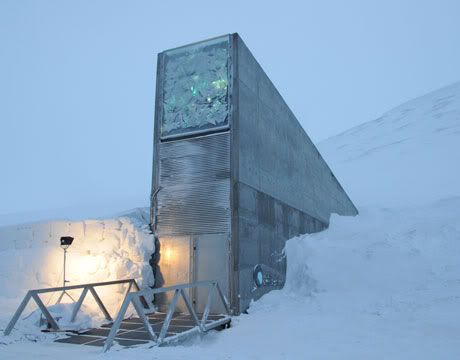
Deep in the Arctic, carved inside a stone mountain, lies the Doomsday Vault. It's a locked, airtight structure that contains something more precious than money or gold. It carries seeds. Half a million variety of crops from different countries all over the world.  It's our safety deposit box against climate change, wars or any catastrophes.

Last week, several chili pepper seeds like, Wenk's Yellow Hots, Pico de Gallos (this a common ingredient in salsa) and San Juan Tsile were added to the collection.  They were delivered by a delegation of US Senators.

"The journey of the chili pepper from the indigenous cultures of the Americas to its current status as an essential ingredient in many Indian and Asian cuisines is a marvelous example of the global disbursement of agricultural diversity," Senator Tom Udall said. "I'm very pleased that we are saving one of New Mexico's most famous and most delicious crops in the Svalbard Global Seed Vault."

Besides chili, they also brought other seeds like peanuts and melons. There is now approximately 250 million seeds in the vault, with each variety having 500 seeds.  Check out their database here.  We can expect that number to grow in the future, but I hope we don't have use them anytime soon.

Sources:
http://en.wikipedia.org/wiki/Svalbard_Global_Seed_Vault
http://www.valleymorningstar.com/news/spices-76967-chili-vault.html
http://news.bbc.co.uk/2/hi/science_and_environment/10603656.stm

Linggo, Hunyo 27, 2010

like death warmed over

Crematoriums in Sweden found a sustainable way to cut costs and be environmentally-friendly. After cremating a body, they will be reusing the exhaust produced to keep their building warm, instead of releasing it out into the air. They are also planning to expand and use the energy for homes as well, making them a crematorium power station. It's a controversial idea but certainly not a bad one (for me at least!).


Aside from human corpses, they have also turned on stray rabbits as energy source.  These animals overpopulate some their parks and destroy plants and trees.  Thousands are killed each year.  So what they do is they bring these dead rabbits to a heating plant to be cremated.  The heat is then redirected to the homes in Värmland, Sweden.

Aside from rabbits, other animal carcasses and wastes are used to produce energy.  They call this fuel, Biomal.  Here's a simple chart I got from treehugger that shows the process:


From Biomal.com: "..The raw material is just crushed and grinded and then pumped to a fluidised bed boiler where it is co-combusted together with a base fuel such as wood chips, peat or municipal waste. Energy is recovered from the animal by-products by producing renewable heat and electricity and the net outcome of energy is considerably increased."

Recently, Taiwan also adopted the cremation idea.  Instead of heating though, Taipei Mortuary Services Office will be using it to power the air-conditioning system of their receiving area and possibly the lighting system of their building.

Sources:
http://www.independent.co.uk/life-style/house-and-home/cremated-bodies-to-power-aircon-in-taiwan-1801115.html
http://www.treehugger.com/files/2010/05/cow-carcasses-heat-swedish-homes.php
http://www.spiegel.de/international/zeitgeist/0,1518,654916,00.html
http://www.freerepublic.com/focus/news/2156917/posts

Sabado, Hunyo 19, 2010

what makes a dad

God took the strength of a mountain,
The majesty of a tree,
The warmth of a summer sun,
The calm of a quiet sea,
The generous soul of nature,
The comforting arm of night,
The wisdom of the ages,
The power of the eagle's flight,
The joy of a morning in spring,
The faith of a mustard seed,
The patience of eternity,
The depth of a family need,
Then God combined these qualities,
When there was nothing more to add,
He knew his masterpiece was complete,
And so, he called it
Dad.

~unknown

Martes, Abril 13, 2010

butterfly alphabet

I'm back!

My first find is Kjell Sandved's Butterfly Alphabet. It's an amazing collection of photos, composed of letters and numbers found on the wings of butterflies and moths.


Kjell, an author and researcher, was trying to put together a new encyclopedia about animals. He
went to the Smithsonian to buy archive photographs but instead found the silver letter, "F", on the wings of an orange Sphinx moth. The moth was in a cuban cigar box, hidden in a corner of an attic in the National Museum of Natural History. He decided to drop his animal encyclopedia project, and chose to capture all letters and numbers on moth and butterfly wings instead.

There was a problem though: “I had hardly clicked a camera before,” Kjell relates, “and knew nothing about photography.” So he studied, and it took him two years to learn still and movie photography. During this time, he and a friend created customized electronic gear from scraps found in a nearby WWII Navy Yard surplus.

In his quest to find the letters and numbers, he travelled to the forests of the Amazon, the Congo, Papua New Guinea and the Philippines. He survived malaria, snakebite, leeches, numerous jungle ants and rabid dog bites. The easiest letters to find were O, C, D, I, L and M. This is because according to him, "Design elements in nature, tend to go toward symmetry." Asymmetrical letters, like B, H, K, Q, T and X required more time. His biggest challenge is the letter G. He found it on the wing of the Catagramma butterfly. It took him 24 years to complete the collection.

The discovery was featured in the then new Smithsonian magazine. They created posters and slogans for Queen Elizabeth II and Emperor Hirohito during their visits to the institution. It also boosted interest in butterfly gardening and rearing. Today, the poster is also used by some as a tool in teaching the alphabet to children.

Kjell found letters and numbers in other plants and animals as well. Here's a leaf in the shape of the letter F. He found this near a fisherman's hut in Fiji. See the others here.


He says modern man has lost his ability to appreciate the small things in nature. He's worried this is already happening to children. "They have so little access to real things because they're taken away from the land. In the cities, with only concrete and steel, it's worst." Through his butterfly alphabet, a child can learn to read and at the same time, appreciate the incredible beauty of nature.

That is something that never fails to amaze Kjell, even with his decades of experience. There is a line from Roethke printed in his posters: "All finite things reveal infinitude."

"This is one of the deepest statements I can think of that has ever been uttered in science and life," he says. "The more I learn, the more I see that I'm totally ignorant." Our brains, according to him, are like boxes, it can be hard to think outside of what we are comfortable with. So instead of trying to figure it all out, he just watches in amazement. He chases and captures all the world's wonders in his photographs.

Sources:
http://www.sciencenewsforkids.org/articles/20051116/Feature1.asp
http://www.butterflyalphabet.com/story/index.php
http://en.wikipedia.org/wiki/Butterfly_Alphabet
http://en.wikipedia.org/wiki/Kjell_B._Sandved
http://www.webcitation.org/5XnAYXRQ7

Miyerkules, Marso 10, 2010

aliens beneath us


We were working overtime the other day when somebody said something about how scientists found creatures living inside our planet. He said it's like "Journey to the Center of the Earth". I thought he was just tired, but that caught my interest so I looked it up. Turns out there is such a thing as intraterrestrial life. Deep into the earth, there's another biosphere where microorganisms thrive. These life forms are a lot like what we'd expect to see in Mars and other planets, extraterrestrial aliens.


For the next two years, three drill ship expedition will be launched to "punch holes in the seafloor and implant long-term scientific 'observatories' linked by cable and satellite to onshore laboratories." This is very exciting, who knows what they might find? Maybe it really is like Journey.

But I read some more articles and found that one of the reasons they're doing this is to search for something that could help solve the problems in our environment today. An example is, they're thinking of putting all the excess carbon dioxide below the seafloor. I don't know how in the world they're going to do that-- besides, what will be the effect of all that carbon dioxide? I don't think anybody knows. Then there's also a theory that below the seafloor are reservoirs of water similar to what we have in our rivers here now, so that means we'll have another water source.

Sometimes, I really think that we'll never be able to solve the problems we have today: pollution, climate change, overpopulation and shortage of gas, food, water. It's already too late. There's a lot of possibility with this discovery, and yet it seems we're just looking for another place to dump our garbage and furnish our supplies. What will happen in the future if the planet can no longer provide?

Source:
http://www.popsci.com/science/article/2010-03/deep-sea-drilling-rig-probe-ocean-floor-undiscovered-lifeforms
Buried alive: Half of Earth's life may lie below land, sea
http://bee.oregonstate.edu
http://ufo.whipnet.org/alien.races/intraterrestrial/index.html

Linggo, Enero 31, 2010

levi & leaf


by walter villa
Out of a single unremarkable leaf came beautiful music.  I remember seeing him on TV back when I was still a kid. Days after that we were trying to do the same thing with Stork candy wrappers. All I was able to play was one single note. It's a lot like whistling but it's hard to get a melody going. Besides it's really embarrassing to have other kids watch you spit all over yourself.

We did try using leaves but they tend to fall apart and we always end up having these bugs in our mouth.  (Amateurs! There goes our chance for the Guinness Book of World Records.)

He composed the lyrics of one of the beautiful, saddest songs I heard.  "Sa Ugoy ng Duyan" is a song of someone longing for his childhood, back when his mother would sing lullabies while gently swaying him to sleep.  I don't know why but I always associate this song to the story of Sisa in Rizal's Noli Me Tangere, a caring mother who lost her mind when her two sons were accused of stealing and were captured by the authorities.

In this age of remakes and rock bands, Levi Celerio's original compositions are diamonds, classics that I hope will never get lost in time.

Levi Celerio
(April 30, 1910 - April 2, 2002)


Lunes, Enero 11, 2010

seeing beauty


There's a kind of beauty that's obvious to everyone, like the beauty of a rose or the sunrise. I think it's a rare thing, because it manages to be appealing to most of us. It manages to shine through anything blurring our vision: race, culture, background, mood swings. It's plain to see, usually belonging to the most common and simple things.

I saw a documentary in Discovery channel that says we are drawn to symmetry. The more symmetrical the face, the more beautiful it is for most of us, so maybe that's the key. Then they did an interesting experiment where they took a bunch of unique faces and combined them into one composite image. The resulting image looked better than the other faces. So the more common the face, the more beautiful it is. They call it the "averageness-effect".

There's another type of beauty that can only be seen through the eyes of a select few. Members of the Padaung tribe from Myanmar find long necks attractive. Women wear neck rings that push their shoulders down and stretch their neck. In China, bound feet were considered erotic. Some tribes in Africa put on lip plates and in Mauritania, women are forced to be fat, both are a mark of beauty and status.


I don't understand how these can be beautiful. But I guess beauty is also a matter of perspective, and our perspectives can always change. I've been fat my whole life and I always saw my body as ugly. Then, while I was researching for this article, I came across the Adipositivity Project - "a visual display of fat physicality. The sort that's normally unseen." and it's amazing, the photos are gorgeous!

Finally, I think the most elusive beauty is the one that people grow into. Some people go through hardships and come out of it wiser and stronger than ever, and that makes them beautiful to everyone they meet. Or it could be that as we get to know someone more, they gradually become the loveliest people we know.

I was watching Avatar yesterday and (SPOILERS!) there was a scene in the end where the girl alien meets the human form of the guy she loves. They look at each other and they just didn't care that they were so different. I loved that moment. They're seeing it, the beauty in each of us that not everyone will catch a glimpse of.

Be that as it may, beauty will always be there.

Sources:
http://library.thinkquest.org/J0111742/neckstretching.htm
http://www.funtasticus.com/2008/10/30/african-beauty-lip-plates
http://adipositivity.my-expressions.com
http://7uncle.wordpress.com/2009/01/29/cinderella-was-born-as-yeh-hsien/


Huwebes, Disyembre 31, 2009

firecrackers

One of our dogs died today, Fuji. She had been with us for more than 10 years. Every New Year's eve, she always hid at the back of the house, scared of the sound of the firecrackers. I remember, there was even a time when she surprised us by leaping over a 5 feet wall (with the help of the washing machine) because of the noise.  We laughed.  She was not a big dog, and looking at her, you'd never know she would be able to jump that high.

A few days before she died she can no longer stand up. Her legs were twisted with arthritis and she refused to eat. We all knew it was only a matter of time. My aunt and mom were always telling me that we should just have her "put to sleep". I refused. She had survived a lot of things before and came back stronger than ever, I feel like she deserved all the life she can get. I did my best to take care of her. I imagined her, an old dog, closing her eyes, dying peacefully in her sleep.

But it wasn't like that at all. It got to the point where it was painful to just look at her. She was so thin and, yesterday, she had saliva dripping from her mouth. She was barking (sort of) and we couldn't do anything but wait. She died with her eyes open. We buried her this morning. In the afternoon, we saw a butterfly with purple spots in the place where she died. I believe it was her, saying goodbye.

It's now 5:14 pm here and already I can hear firecrackers outside. The usual stuff: trianggulo, plapla, bawang, etc. Looking at them, you'd never know they were packing so much power and could make that much noise. What a way to end the year, crying while writing a blog entry. I miss her.

Linggo, Oktubre 25, 2009

connections

Here's a picture I took of our pets taking a nap after a big lunch (check out that belly). We've always been curious why these dogs never fought with the cat.

our pets
our pets

They bark at other cats but not this one, they always got along. How does one being connect with another? Here are other pairings that show how friends can come in all forms and sizes.


Suryia and Roscoe
Suryia and Roscoe
suryiaandroscoe.com
"Roscoe looked really thin and a little lost so we fed him and took care of him. He followed us through the gate and ran over and found Suryia. As soon as he saw Roscoe, Suryia ran over to him and they started playing. It was unusual because dogs are usually scared of primates but they took to each other straight away. We made a few calls to see if he belonged to anyone and when no-one came forward, Roscoe ended up staying.", says Dr. Bhagavan Antle, founder of The Institute of Greatly Endangered and Rare Species (TIGERS).


Owen and Mzee
Owen and Mzee
owenandmzee.com
 “It is incredible! A less-than-a-year-old hippo has adopted a male tortoise, about a century old, and the tortoise seems to be very happy with being a ‘mother’,” ecologist Paula Kahumbu, who is in charge of Lafarge Park, told AFP. “After it was swept away and lost its mother, the hippo was traumatized. It had to look for something to be a surrogate mother. Fortunately, it landed on the tortoise and established a strong bond. They swim, eat and sleep together. The hippo follows the tortoise exactly the way it follows its mother. If somebody approaches the tortoise, the hippo becomes aggressive, as if protecting its biological mother,” Kahumbu added.  


Tarra and Bella
Tarra and Bella
elephants.com
"When it's time to eat they both eat together. They drink together. They sleep together. They play together," says Carol Buckley, co-founder of the Elephant Sanctuary in Hohenwald, Tennesee. Bella, the dog even lets Tarra pet her tummy. When she suffered a spinal cord injury, Tarra visited and just stood outside the sanctuary office for days until she was able to walk. "She just stood outside the balcony - just stood there and waited," says Buckley.

 I noticed that most of these connections started when they were either very young or have experienced loss.  I guess some special bonds are formed when one is at his weakest and the other willingly gives time to be his companion.  There's no big secret, nothing spectacular needed in order to connect-- you don't even have to be from same species. You simply have to be there.

Sources: 
http://www.suryiaandroscoe.com/their_story.asp 
http://www.floristone.com/hippopotamus-tortoise.html http://www.cbsnews.com/stories/2009/01/02/assignment_america/main4696340.shtml

Sabado, Oktubre 3, 2009

a diamond in the rough

from lifegem.com
lifegem.com
Did you know that a part of us can be physically transformed into a diamond? Diamonds are created from Carbon and about 18% of our mass is made up of that stuff. It can be extracted from a lock of our hair or from a deceased person's ashes. Once extracted, it needs to be subjected to extreme heat and pressure, the same process that authentic diamonds go through. This will convert the Carbon into diamond crystals. The crystals can then be cut and designed and the resulting gem is set in a ring or a necklace or whatever piece you'd like.

It's amazing to realize that we can produce something so beautiful. Last week, I was having lunch with some people and I accidentally drooled on myself. The saliva spilled out of my mouth and sort of yo-yo'd down my shirt. One of them saw it, pointed and laughed at me. It would've been easier if everybody laughed but they didn't. So I just looked down on my shirt and wiped it off, and then I remained quiet the whole time. I just get so disgusted with myself sometimes.

I'm sure I'm not the only one with this kind of experience. It's hilarious when it happens to other people but when it's us, sometimes it's hard to get over the embarassment. Sure it will be funny when we look back on it, but when you're in that moment, you just want to die. It just makes your self-hatred turn up a notch.

There's no way around it, these things just happen out of the blue. There are even people who laugh at us even if we didn't do anything embarassing. One thing I hate about myself is I make people laugh at me to get them to like me. I humiliate myself and clown around. It's a habit I'm trying to break-- and I'm still working on loving myself enough to stop it. I know it will take a long time, building your self-respect and coming to terms with yourself, learning, getting back up, reflecting and improving.

However painful, I think these things that we're ashamed of are part of the whole process of becoming better, some sort of baptism by fire. We'll just have to suck it up and cope with the pressure as well as we can-- without letting it harden us. Hopefully, we'll come out of it wiser and radiant, beautiful like diamonds.
di5vwkgcx6


Sources:
http://www.lifegem.com

Linggo, Setyembre 27, 2009

ondoy / ketsana

Ondoy (Ketsana)
www.pagasa.dost.gov.ph
Yesterday, I was trying to write a post when I heard my mother yelling at someone on the phone.  She was near panic because there was a big flood on the other side of our subdivision where some of our relatives are living.  They live near a creek and the water overflowed.  We didn't have any problems on our side so I thought the rain was no big deal but as it turns out, it's a different story for the other areas of the Metro.

We were all worried of what could happen if the rain didn't let up.  A lot of houses were already submerged in water.  People, including children, are on the roof of their houses or on elevated parts of street, helpless and waiting out the storm.  Some are guarding their appliances because it might get stolen.  They were also worried about the electricity.  One live wire plus flood equals hell.

My mom paid two guys to fetch our cousins.  They passed one street where the water was chest high, so one of the kids had to be carried.  They also had to be careful of open manholes while dodging the trash and cockroaches drifting on the flood.  They were crying when they arrived at our place.  Their mother was left behind, guarding the house and things while their father had gone off to work and had been stranded for hours.

The downpour slowed down in the evening and soon, our aunt was able to go visit us.  The kids ran and hugged her, she just laughed it off.  We gave her a blanket and some old clothes to bring back to the others who didn't have anything to wear.  They spent the night at our house.

Today, the sun is out and the storm moves on but water is still everywhere.  The weather bureau says that nearly a month’s worth of rain fell in just six hours over Metro Manila.  Consequently, Marikina and Pasig River overflowed.  We had local movie stars calling TV programs from their rooftops asking to be rescued.  A lot of people are still stranded and couldn't get home to their loved ones who are trapped and helpless.  As of 10 am today, more than forty people have died and there are some that are still missing.

There's a news program right now, where you can call in and pledge a donation.  One of the hosts was trying to rationalize, saying that this is God's way of making us realize that we need to call him and he's making us strong.  Other people are blaming the Government for not fixing the drainages and spending millions of emergency fund money for foreign trips.  Some point a finger to humanity for destroying nature.  However way you want to look at it, I think all of us contributed to the problem.

The challenge of this blog is to see the good in things but right now, I don't think there's anything good in this tragedy.  I'd like to agree with the host and say that this will make us strong and united and all that, but really, isn't it a whole lot better if the storm didn't happen in the first place?  I'd still prefer to live in a flawless world, thank you very much-- but that will never happen will it?  Shit happens every single day and the chances of us living in a harmonious environment with the perfect climate are growing slimmer every second.  No, I don't think I'll be able to find the good in here-- but I'm hoping that we'll be able to find the good in us.


Donations to The Red Cross Rescue and Relief Operations can be sent via Globe or Smart. Send RED (space) (amount) to 2899 (Globe) and 4483 (SMART). Donations can be made at 10, 25, 50 and 100. Kindly repost this.

http://helpondoyvictims.wordpress.com/
http://pedestrianobserver.blogspot.com/2009/09/help-ondoy-victims-in-philippines.html
3 drop-off areas designated for Ondoy victims' donations

Miyerkules, Setyembre 16, 2009

the father of the green revolution


2006 Norman Borlaug Congressional Gold Medal
"When the Nobel Peace Prize Committee designated me the recipient of the 1970 award for my contribution to the 'green revolution', they were in effect, I believe, selecting an individual to symbolize the vital role of agriculture and food production in a world that is hungry, both for bread and for peace." - Dr. Norman Ernest Borlaug (1914-2009)

Norman Borlaug was born on a farm near Cresco, Iowa in March 25 1914.  He spent his childhood and teenage years working with the crops and animals.  In 1933, at the urging of his grandfather, he left the farm and enrolled at the University of Minnesota.

His encounters with the unemployed and the starving during the Great Depression shaped his outlook on life.  It was also around this time that he met Prof. Elvin Stakman.  He became involved in Stakman's research on plant breeding methods and the professor suggested that he take up Plant Pathology.

In 1944, he became part of The Cooperative Wheat Research Production Program, which focused on increasing wheat production in Mexico.  It was not easy.  They didn't have enough training and equipment, and the local farmers refused to cooperate.  The epilogue of his book, "Norman Borlaug on World Hunger", reveals his initial regret.  He wrote: "It often appeared to me that I had made a dreadful mistake in accepting the position in Mexico,".

But after several years of research, harvest time finally arrived.   He developed Pitic 62 and Penjamo 62, two disease-resistant varieties of wheat that produced more grain than usual.  By 1963, Mexico achieved production six times larger than in 1944.  95 percent of the crops were Borlaug's varieties.

After Mexico, his wheat strains were sent to India and Pakistan.  In five years, Pakistan's wheat yields increased dramatically from 4.6 million tons to 7.3 million tons.  By 1968, Pakistan became self-sufficient in wheat production.

India produced 20.1 million tons of wheat in 1970. There wasn't enough labor to harvest the crops; not enough carts to bring it to the threshing floor; not enough jute bags, trucks, rail cars, and grain storage facilities. They even closed down schools to use the buildings for grain storage.  They were also able to save 100 million acres of virgin land from being converted into farmland.

He began work in Africa in 1984 with Ryoichi Sasakawa, chairman of Japan Shipbuilding Industry Foundation.  Production of maize, sorghum, wheat, cassava and cowpeas increased.  The project will also be extended to Benin, Burkina Faso, Ethiopia, Ghana, Guinea, Mali, Malawi, Mozambique, Nigeria, Tanzania, and Uganda.

Norman Borlaug passed away last Saturday, Sept 12, 2009 at the age of 95.  He died of lymphoma.  A lot of us, though, didn't know who he was until now.  Scientists predicted that a global famine will happen because of the population explosion, but Norman's discoveries saved us all.  He led a very fruitful life that has yielded much to humanity.

Sources:
http://en.wikipedia.org/wiki/Norman_Borlaug
http://news.yahoo.com/s/ap/20090913/ap_on_re_us/us_obit_borlaug