A long time ago, explorers made great voyages across the seas to discover the world. They spent a lot of money on massive ships, tons of supplies and crew members. They searched for unknown lands to conquer, traded products with other countries, made maps and sailed by the stars. It was a tough, expensive and dangerous adventure. It took them a long time to travel and some of them never even returned to their homeland.
Today, we can be an explorer and never leave our favorite couch. We can even multitask, navigating the Earth while watching our favorite TV show. There's still a lot of ground to cover, and everyday, people see something cool and exciting. Thanks to Google Earth, a lot of people have uncovered armchair discoveries. Here are two of the great ones found:
The Badlands Guardian
Alberta, Canada
50° 0'38.20"N 110° 6'48.32"W
You don't even have to squint to see a person wearing earphones and a native American headdress. It was found by Lynn Hickox, a 53 year old lady who lives in Canada.
"I was just looking around - I hadn't been on for long - and I just saw it. It jumped out at me," she said. "You had all those explorers who had to traipse miles and miles and here I am just sitting here at the computer with a mouse."
Soil erosion formed the face, while the earphone is a road and an oil well. I'd like to believe that this was not a coincidence at all, but that it came from the spirit of an ancient Indian warrior and he's really here to guard the land. Maybe this was his land before. Then, maybe, a native elder somewhere will see this and recognize the face. Oooh..
Anyway, after Lynn found it, she logged in on Google Earth forum as "Supergranny" to post her discovery. She became a bit of a celebrity in her hometown when a radio program held a contest to name her find. Some of the entries were Space Face, Chief Bleeding Ear, The Listening Rock, Jolly Rocker, Pod God, iChief, Chief M-P-Three and Az-tech.
An Ancient Roman Villa
near Parma, Italy
44.8819,10.4224
I'm having a hard time seeing it too
Luca Mori, a computer programmer from Italy, stumbled upon this one. He was going through the map of Sorbolo, Parma when he noticed strange shapes in their area-- an oval form about 500 meters long and rectangular shadows.
"At first I thought it was a stain on the photograph but when I zoomed in I saw that there was something under the earth," he said.
The National Archaeological Museum of Parma sent archeologists to investigate.
"At first they thought the site might be Bronze Age but a closer inspection turned up ceramic and stone pieces that showed it was a Roman villa built some time just before the birth of Christ", he said.
-=-=-=-=-=-=-=-=-=-=-=-=-=-=-=-
Another fascinating place armchair explorers can go is deep into the ocean. They can visit shipwrecks, track the migration of whales and even see the underwater mountains and valleys in high resolution. It's amazing to see just how much technology can do today.
I found a great site that gathers all cool things found in Google Maps: http://www.mapofstrange.com/. Here's my favorite, elephants in Africa!
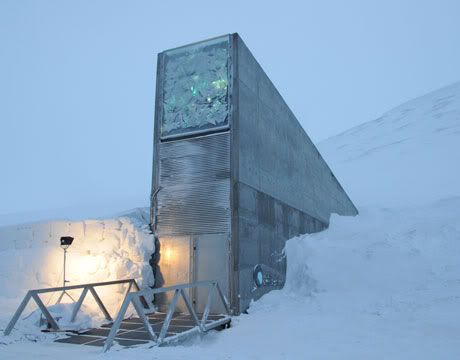
Deep in the Arctic, carved inside a stone mountain, lies the Doomsday Vault. It's a locked, airtight structure that contains something more precious than money or gold. It carries seeds. Half a million variety of crops from different countries all over the world. It's our safety deposit box against climate change, wars or any catastrophes.
Last week, several chili pepper seeds like, Wenk's Yellow Hots, Pico de Gallos (this a common ingredient in salsa) and San Juan Tsile were added to the collection. They were delivered by a delegation of US Senators.
"The journey of the chili pepper from the indigenous cultures of the Americas to its current status as an essential ingredient in many Indian and Asian cuisines is a marvelous example of the global disbursement of agricultural diversity," Senator Tom Udall said. "I'm very pleased that we are saving one of New Mexico's most famous and most delicious crops in the Svalbard Global Seed Vault."
Besides chili, they also brought other seeds like peanuts and melons. There is now approximately 250 million seeds in the vault, with each variety having 500 seeds. Check out their database here. We can expect that number to grow in the future, but I hope we don't have use them anytime soon.
Crematoriums in Sweden found a sustainable way to cut costs and be environmentally-friendly. After cremating a body, they will be reusing the exhaust produced to keep their building warm, instead of releasing it out into the air. They are also planning to expand and use the energy for homes as well, making them a crematorium power station. It's a controversial idea but certainly not a bad one (for me at least!).
Aside from human corpses, they have also turned on stray rabbits as energy source. These animals overpopulate some their parks and destroy plants and trees. Thousands are killed each year. So what they do is they bring these dead rabbits to a heating plant to be cremated. The heat is then redirected to the homes in Värmland, Sweden.
Aside from rabbits, other animal carcasses and wastes are used to produce energy. They call this fuel, Biomal. Here's a simple chart I got from treehugger that shows the process:
From Biomal.com: "..The raw material is just crushed and grinded and then pumped to a fluidised bed boiler where it is co-combusted together with a base fuel such as wood chips, peat or municipal waste. Energy is recovered from the animal by-products by producing renewable heat and electricity and the net outcome of energy is considerably increased."
Recently, Taiwan also adopted the cremation idea. Instead of heating though, Taipei Mortuary Services Office will be using it to power the air-conditioning system of their receiving area and possibly the lighting system of their building.
I think I'm the last netizen to know about Google's Pac-Man interactive logo.
I woke up today and read some updates about it on Facebook. Then I spent most of the morning playing-- very productive. Good thing it's weekend here. I read some companies temporarily blocked Google last Friday because people can't resist playing.
When the game's over, Google automatically redirects you to the search results for "PAC-MAN 30th Anniversary". I read on and got to know Pac-Man better:
His son's girlfriend is a ghost monster
His prehistoric ancestors were the Neander-pac. They were shaped like cubes.
I remember reading this speech right after I finished watching Pirates of Silicon Valley. I was on the net, hungry for more stories and trivias about Steve Jobs, Bill Gates and everyone in it. Then I came across this, and I'm really glad I did. I love the anecdotes and advices he gave. I've also read the one from Bill Gates and I think it's good too, but I like this one better because it's easy to read and it held my attention all the way to the end.
Commencement Address to the Stanford Class of 2005 by Steve Jobs
I am honored to be with you today at your commencement from one of the finest universities in the world. I never graduated from college. Truth be told, this is the closest I've ever gotten to a college graduation. Today I want to tell you three stories from my life. That's it. No big deal. Just three stories.
The first story is about connecting the dots.
I dropped out of Reed College after the first 6 months, but then stayed around as a drop-in for another 18 months or so before I really quit. So why did I drop out?
It started before I was born. My biological mother was a young, unwed college graduate student, and she decided to put me up for adoption. She felt very strongly that I should be adopted by college graduates, so everything was all set for me to be adopted at birth by a lawyer and his wife. Except that when I popped out they decided at the last minute that they really wanted a girl. So my parents, who were on a waiting list, got a call in the middle of the night asking: "We have an unexpected baby boy; do you want him?" They said: "Of course." My biological mother later found out that my mother had never graduated from college and that my father had never graduated from high school. She refused to sign the final adoption papers. She only relented a few months later when my parents promised that I would someday go to college.
And 17 years later I did go to college. But I naively chose a college that was almost as expensive as Stanford, and all of my working-class parents' savings were being spent on my college tuition. After six months, I couldn't see the value in it. I had no idea what I wanted to do with my life and no idea how college was going to help me figure it out. And here I was spending all of the money my parents had saved their entire life. So I decided to drop out and trust that it would all work out OK. It was pretty scary at the time, but looking back it was one of the best decisions I ever made. The minute I dropped out I could stop taking the required classes that didn't interest me, and begin dropping in on the ones that looked interesting.
It wasn't all romantic. I didn't have a dorm room, so I slept on the floor in friends' rooms, I returned coke bottles for the 5¢ deposits to buy food with, and I would walk the 7 miles across town every Sunday night to get one good meal a week at the Hare Krishna temple. I loved it. And much of what I stumbled into by following my curiosity and intuition turned out to be priceless later on. Let me give you one example:
Reed College at that time offered perhaps the best calligraphy instruction in the country. Throughout the campus every poster, every label on every drawer, was beautifully hand calligraphed. Because I had dropped out and didn't have to take the normal classes, I decided to take a calligraphy class to learn how to do this. I learned about serif and san serif typefaces, about varying the amount of space between different letter combinations, about what makes great typography great. It was beautiful, historical, artistically subtle in a way that science can't capture, and I found it fascinating.
None of this had even a hope of any practical application in my life. But ten years later, when we were designing the first Macintosh computer, it all came back to me. And we designed it all into the Mac. It was the first computer with beautiful typography. If I had never dropped in on that single course in college, the Mac would have never had multiple typefaces or proportionally spaced fonts. And since Windows just copied the Mac, its likely that no personal computer would have them. If I had never dropped out, I would have never dropped in on this calligraphy class, and personal computers might not have the wonderful typography that they do. Of course it was impossible to connect the dots looking forward when I was in college. But it was very, very clear looking backwards ten years later.
Again, you can't connect the dots looking forward; you can only connect them looking backwards. So you have to trust that the dots will somehow connect in your future. You have to trust in something — your gut, destiny, life, karma, whatever. This approach has never let me down, and it has made all the difference in my life.
My second story is about love and loss.
I was lucky — I found what I loved to do early in life. Woz and I started Apple in my parents garage when I was 20. We worked hard, and in 10 years Apple had grown from just the two of us in a garage into a $2 billion company with over 4000 employees. We had just released our finest creation — the Macintosh — a year earlier, and I had just turned 30. And then I got fired. How can you get fired from a company you started? Well, as Apple grew we hired someone who I thought was very talented to run the company with me, and for the first year or so things went well. But then our visions of the future began to diverge and eventually we had a falling out. When we did, our Board of Directors sided with him. So at 30 I was out. And very publicly out. What had been the focus of my entire adult life was gone, and it was devastating.
I really didn't know what to do for a few months. I felt that I had let the previous generation of entrepreneurs down - that I had dropped the baton as it was being passed to me. I met with David Packard and Bob Noyce and tried to apologize for screwing up so badly. I was a very public failure, and I even thought about running away from the valley. But something slowly began to dawn on me — I still loved what I did. The turn of events at Apple had not changed that one bit. I had been rejected, but I was still in love. And so I decided to start over.
I didn't see it then, but it turned out that getting fired from Apple was the best thing that could have ever happened to me. The heaviness of being successful was replaced by the lightness of being a beginner again, less sure about everything. It freed me to enter one of the most creative periods of my life.
During the next five years, I started a company named NeXT, another company named Pixar, and fell in love with an amazing woman who would become my wife. Pixar went on to create the worlds first computer animated feature film, Toy Story, and is now the most successful animation studio in the world. In a remarkable turn of events, Apple bought NeXT, I returned to Apple, and the technology we developed at NeXT is at the heart of Apple's current renaissance. And Laurene and I have a wonderful family together.
I'm pretty sure none of this would have happened if I hadn't been fired from Apple. It was awful tasting medicine, but I guess the patient needed it. Sometimes life hits you in the head with a brick. Don't lose faith. I'm convinced that the only thing that kept me going was that I loved what I did. You've got to find what you love. And that is as true for your work as it is for your lovers. Your work is going to fill a large part of your life, and the only way to be truly satisfied is to do what you believe is great work. And the only way to do great work is to love what you do. If you haven't found it yet, keep looking. Don't settle. As with all matters of the heart, you'll know when you find it. And, like any great relationship, it just gets better and better as the years roll on. So keep looking until you find it. Don't settle.
My third story is about death.
When I was 17, I read a quote that went something like: "If you live each day as if it was your last, someday you'll most certainly be right." It made an impression on me, and since then, for the past 33 years, I have looked in the mirror every morning and asked myself: "If today were the last day of my life, would I want to do what I am about to do today?" And whenever the answer has been "No" for too many days in a row, I know I need to change something.
Remembering that I'll be dead soon is the most important tool I've ever encountered to help me make the big choices in life. Because almost everything — all external expectations, all pride, all fear of embarrassment or failure - these things just fall away in the face of death, leaving only what is truly important. Remembering that you are going to die is the best way I know to avoid the trap of thinking you have something to lose. You are already naked. There is no reason not to follow your heart.
About a year ago I was diagnosed with cancer. I had a scan at 7:30 in the morning, and it clearly showed a tumor on my pancreas. I didn't even know what a pancreas was. The doctors told me this was almost certainly a type of cancer that is incurable, and that I should expect to live no longer than three to six months. My doctor advised me to go home and get my affairs in order, which is doctor's code for prepare to die. It means to try to tell your kids everything you thought you'd have the next 10 years to tell them in just a few months. It means to make sure everything is buttoned up so that it will be as easy as possible for your family. It means to say your goodbyes.
I lived with that diagnosis all day. Later that evening I had a biopsy, where they stuck an endoscope down my throat, through my stomach and into my intestines, put a needle into my pancreas and got a few cells from the tumor. I was sedated, but my wife, who was there, told me that when they viewed the cells under a microscope the doctors started crying because it turned out to be a very rare form of pancreatic cancer that is curable with surgery. I had the surgery and I'm fine now.
This was the closest I've been to facing death, and I hope its the closest I get for a few more decades. Having lived through it, I can now say this to you with a bit more certainty than when death was a useful but purely intellectual concept:
No one wants to die. Even people who want to go to heaven don't want to die to get there. And yet death is the destination we all share. No one has ever escaped it. And that is as it should be, because Death is very likely the single best invention of Life. It is Life's change agent. It clears out the old to make way for the new. Right now the new is you, but someday not too long from now, you will gradually become the old and be cleared away. Sorry to be so dramatic, but it is quite true.
Your time is limited, so don't waste it living someone else's life. Don't be trapped by dogma — which is living with the results of other people's thinking. Don't let the noise of others' opinions drown out your own inner voice. And most important, have the courage to follow your heart and intuition. They somehow already know what you truly want to become. Everything else is secondary.
When I was young, there was an amazing publication called The Whole Earth Catalog, which was one of the bibles of my generation. It was created by a fellow named Stewart Brand not far from here in Menlo Park, and he brought it to life with his poetic touch. This was in the late 1960's, before personal computers and desktop publishing, so it was all made with typewriters, scissors, and polaroid cameras. It was sort of like Google in paperback form, 35 years before Google came along: it was idealistic, and overflowing with neat tools and great notions.
Stewart and his team put out several issues of The Whole Earth Catalog, and then when it had run its course, they put out a final issue. It was the mid-1970s, and I was your age. On the back cover of their final issue was a photograph of an early morning country road, the kind you might find yourself hitchhiking on if you were so adventurous. Beneath it were the words: "Stay Hungry. Stay Foolish." It was their farewell message as they signed off. Stay Hungry. Stay Foolish. And I have always wished that for myself. And now, as you graduate to begin anew, I wish that for you.
We were working overtime the other day when somebody said something about how scientists found creatures living inside our planet. He said it's like "Journey to the Center of the Earth". I thought he was just tired, but that caught my interest so I looked it up. Turns out there is such a thing as intraterrestrial life. Deep into the earth, there's another biosphere where microorganisms thrive. These life forms are a lot like what we'd expect to see in Mars and other planets, extraterrestrial aliens.
For the next two years, three drill ship expedition will be launched to "punch holes in the seafloor and implant long-term scientific 'observatories' linked by cable and satellite to onshore laboratories." This is very exciting, who knows what they might find? Maybe it really is like Journey.
But I read some more articles and found that one of the reasons they're doing this is to search for something that could help solve the problems in our environment today. An example is, they're thinking of putting all the excess carbon dioxide below the seafloor. I don't know how in the world they're going to do that-- besides, what will be the effect of all that carbon dioxide? I don't think anybody knows. Then there's also a theory that below the seafloor are reservoirs of water similar to what we have in our rivers here now, so that means we'll have another water source.
Sometimes, I really think that we'll never be able to solve the problems we have today: pollution, climate change, overpopulation and shortage of gas, food, water. It's already too late. There's a lot of possibility with this discovery, and yet it seems we're just looking for another place to dump our garbage and furnish our supplies. What will happen in the future if the planet can no longer provide?
In a study published by The New England Journal of Medicine, researchers found that some coma patients may have the ability and the awareness to communicate.
When an area of the brain is active, blood flows through it. So going by this fact, they asked the patients (even though they're not sure if the patients can actually hear them) to imagine different scenes that will activate the different areas of the brain. An image of a forehand stroke hitting a tennis ball means Yes, while a scene of themselves navigating their way around a familiar place means No. The first one turns on the motor or the movement part, and the second one uses the spatial part of the brain. The researchers then monitored the blood activity using a brain scan.
One patient, a 29 year old vehicular accident victim, answered 5 out of 6 personal questions correctly. He was believed to be unconscious for five years. They were all wrong.
His father's name is Alexander.
"We were astonished when we saw he was able to correctly answer questions asked by simply changing his thoughts.", says Dr. Adrian Owen, leader of the team that developed this technique in Cambridge. "Not only did these scans tell us that the patient was not in a vegetative state, but, more importantly, for the first time in five years it provided the patient with a way of communicating his thoughts to the outside world."
Thorkil Sonne's son, Lars, was diagnosed with childhood autism at the age of 3. He was devastated but he also noticed something exceptional with the child. “When he starts focusing on something, he is so clever,” he says. “He can learn so much; it’s quite extraordinary.”
It's a trait common to some individuals with ASD (Autism Spectrum Disorder), especially those with Asperger syndrome-- an obssessive focus on things and a remarkable memory. Thorkil recognized these cognitive strengths and soon an idea came to him. In 2004, he got a loan and founded, Specialisterne, an IT company that provides software testing services and data conversion to businesses in Denmark. It's the kind of work that requires focus and accuracy, a perfect fit for people with ASD.
“I have an ability to see when something deviates,” according to Torben Sorensen, a Specialisterne employee. “It kind of leaps to the eye. It’s an ability many people don’t seem to have, but to me it’s natural.”
They don't get bored and lose their focus on repetitive tasks, they don't do office gossip, they're accurate, punctual and thorough, they live on routine. “I think the thing the supervisors really liked most was their work ethic,” says David Hagner from University of New Hampshire Institute on Disability. “If they’re told, ‘Your break is 10 minutes,’ they would take 10 minutes. Not nine or 11. Just 10.”
Currently, Specialisterne has about 50 to 60 employees and approximately 75% are diagnosed with ASD. They do work for companies like Microsoft, CSC, Oracle and Lego. There are plans for expansion and their long term goal is to employ a thousand employees with ASDs worldwide.
This app in Facebook is almost always right on target.
On this day, God wants you to know... ... that difficult people are very important, - they teach you tolerance and acceptance. If all was going your way all the time, you would become a spoiled child, wouldn't everyone? Difficult people are just one of the ways God teaches us to expand beyond our egos and accept other perspectives on life.
For me, there's no such thing as an "easy" person. Everyone's difficult because each of us is unique-- different ways of thinking, backgrounds and views on life, personalities. It's always hard for me to adjust. I get uncomfortable when there's unfamiliar company. Plus when I'm with people, I tend to get the feeling that you have to entertain them. You have to talk about interesting things, you have to talk about yourself, you have to talk about the things you have in common-- you just have to Talk. You have to work and work and work to fill in the silence. Dead air is hell.
I do have friends and I've known them for years. These relationships are time tested and we've gone through a lot. I can count them in one hand though. Most of the people I know, I know that they're just passing through. I work with them, try my very best shot at small talk and that's it. Shallow connections. Why not make them deeper? I don't know. There's always something that prevents me from doing that. Maybe it's me, maybe it's them. Maybe the chemistry isn't right. I don't know. It's just difficult.
It sucks but I believe this is one of life's most important lesson-- tolerance and acceptance. It will be painful and it will take time. Everyone has a reason for doing the things they do, and I have to dig deeper to understand.
Using a software called Pl@giarism, a literature professor was able to detect traces of Shakespeare in an unattributed play from the 1500s titled, "The Reign of Edward III".
The software compares writing patterns between two or more works and produces a list of phrases common to them. It's usually used to check the originality of a student's work. Sir Brian Vickers, from University of London, used it in examining the play and found 200 matches between Edward III and Shakespeare's other works.
"With this method we see the way authors use and reuse the same phrases and metaphors, like chunks of fabric in a weave," says Vickers.
And it looks like this play is a collaboration between Shakespeare and another playwright, Thomas Kyd. There's also a match of 200 phrases between this play and his works.
"In Edward III, it's quite a typical arrangement; Shakespeare writes three scenes near the beginning and one later on, presumably to guarantee some kind of continuity," says Vickers. "It's a very good play, but it suffers from some inconsistencies - characters who appear in some of Shakespeare's scenes don't appear later on."
It took Prof. Vickers two years of research to identify the play's possible authors, even if he has the expertise and the software, it still wasn't easy. "You have to go on hunches - you can't just feed in all the numbers on every play and sit back," he says. "But what I'm hoping to do is bring about a marriage between human reading and machine reading. If you distrust computers, you won't advance at all; if you have just computers and know nothing about literature, you're likely to go wrong as well."
As everyone knows, a huge flood happened here in Manila about a week ago (and there's another storm up north this week). There were several municipalities hit by typhoon Ketsana: Marikina, Rizal, Pasig and Laguna. I'm not sure how accurate this is but I heard that people living in those places are now moving out and selling their PhP 15 million houses for only PhP 5 million. It's a big discount but I don't know if anyone's buying. Most people are now going for real estate situated on higher ground.
Here's an idea, how about getting one of those houses made out of shipping containers? If you want to move, you can simply have your house transported to another lot. It's durable-- designed to withstand tough conditions, as well as cheap and environment friendly.
port-a-bach.com
You need to have it insulated though and I'm not sure what will happen if lightning strikes. Also, you should bolt it down so it doesn't get stolen or displaced when a big flood comes, like what happened here:
shipping container displaced by the flood, stuck on road divider
from PinoyExchange.com - '40 ft. shipping container as a house'
posted by KuyaDanny
For those interested to learn more about this topic, you can visit http://www.shipping-container-housing.com/. It contains tips, links to companies that build container houses, background info on the industry and even a history of shipping containers. According to them, "shipping container housing can represent a real solution to social and ecological problems". I agree. Who knew that inside that cold hard steel lies a warm cozy crib?
Did you know that a part of us can be physically transformed into a diamond? Diamonds are created from Carbon and about 18% of our mass is made up of that stuff. It can be extracted from a lock of our hair or from a deceased person's ashes. Once extracted, it needs to be subjected to extreme heat and pressure, the same process that authentic diamonds go through. This will convert the Carbon into diamond crystals. The crystals can then be cut and designed and the resulting gem is set in a ring or a necklace or whatever piece you'd like.
It's amazing to realize that we can produce something so beautiful. Last week, I was having lunch with some people and I accidentally drooled on myself. The saliva spilled out of my mouth and sort of yo-yo'd down my shirt. One of them saw it, pointed and laughed at me. It would've been easier if everybody laughed but they didn't. So I just looked down on my shirt and wiped it off, and then I remained quiet the whole time. I just get so disgusted with myself sometimes.
I'm sure I'm not the only one with this kind of experience. It's hilarious when it happens to other people but when it's us, sometimes it's hard to get over the embarassment. Sure it will be funny when we look back on it, but when you're in that moment, you just want to die. It just makes your self-hatred turn up a notch.
There's no way around it, these things just happen out of the blue. There are even people who laugh at us even if we didn't do anything embarassing. One thing I hate about myself is I make people laugh at me to get them to like me. I humiliate myself and clown around. It's a habit I'm trying to break-- and I'm still working on loving myself enough to stop it. I know it will take a long time, building your self-respect and coming to terms with yourself, learning, getting back up, reflecting and improving.
However painful, I think these things that we're ashamed of are part of the whole process of becoming better, some sort of baptism by fire. We'll just have to suck it up and cope with the pressure as well as we can-- without letting it harden us. Hopefully, we'll come out of it wiser and radiant, beautiful like diamonds.
"When the Nobel Peace Prize Committee designated me the recipient of the 1970 award for my contribution to the 'green revolution', they were in effect, I believe, selecting an individual to symbolize the vital role of agriculture and food production in a world that is hungry, both for bread and for peace." - Dr. Norman Ernest Borlaug (1914-2009)
Norman Borlaug was born on a farm near Cresco, Iowa in March 25 1914. He spent his childhood and teenage years working with the crops and animals. In 1933, at the urging of his grandfather, he left the farm and enrolled at the University of Minnesota.
His encounters with the unemployed and the starving during the Great Depression shaped his outlook on life. It was also around this time that he met Prof. Elvin Stakman. He became involved in Stakman's research on plant breeding methods and the professor suggested that he take up Plant Pathology.
In 1944, he became part of The Cooperative Wheat Research Production Program, which focused on increasing wheat production in Mexico. It was not easy. They didn't have enough training and equipment, and the local farmers refused to cooperate. The epilogue of his book, "Norman Borlaug on World Hunger", reveals his initial regret. He wrote: "It often appeared to me that I had made a dreadful mistake in accepting the position in Mexico,".
But after several years of research, harvest time finally arrived. He developed Pitic 62 and Penjamo 62, two disease-resistant varieties of wheat that produced more grain than usual. By 1963, Mexico achieved production six times larger than in 1944. 95 percent of the crops were Borlaug's varieties.
After Mexico, his wheat strains were sent to India and Pakistan. In five years, Pakistan's wheat yields increased dramatically from 4.6 million tons to 7.3 million tons. By 1968, Pakistan became self-sufficient in wheat production.
India produced 20.1 million tons of wheat in 1970. There wasn't enough labor to harvest the crops; not enough carts to bring it to the threshing floor; not enough jute bags, trucks, rail cars, and grain storage facilities. They even closed down schools to use the buildings for grain storage. They were also able to save 100 million acres of virgin land from being converted into farmland.
He began work in Africa in 1984 with Ryoichi Sasakawa, chairman of Japan Shipbuilding Industry Foundation. Production of maize, sorghum, wheat, cassava and cowpeas increased. The project will also be extended to Benin, Burkina Faso, Ethiopia, Ghana, Guinea, Mali, Malawi, Mozambique, Nigeria, Tanzania, and Uganda.
Norman Borlaug passed away last Saturday, Sept 12, 2009 at the age of 95. He died of lymphoma. A lot of us, though, didn't know who he was until now. Scientists predicted that a global famine will happen because of the population explosion, but Norman's discoveries saved us all. He led a very fruitful life that has yielded much to humanity.
"Hidden Presents" is one of the quests in the online game, "Asheron's Call". There are 12 gifts hidden throughout the land and you have to find them. One of the characters says, "The only giant gift box I want would be full of ale!". When you find all 12 gifts you will be rewarded with a Polar Ursuin Lair (I don't know what that is) and a title. I found their community wiki here.
I haven't played it yet but I delight in the concept. There's always something joyful in discovery. We're always searching for something new-- places, people, things. There's comfort in the familiar but it's the unknown that almost always brings excitement in our life.
I discovered Asheron's "Hidden Presents" because that was the name I originally wanted for this site. I had been planning this for quite awhile and stupid me, I didn't even bother to recheck google when I registered the domain. So here I am, I just finished researching and going about with my domain change and adjusting the blog. It just doesn't feel right to have the same name as the game.
I'm still getting used to the new name -- "gifts in hiding". I guess while not all discoveries make us excited, most of them makes us a little wiser.




 His father's name is Alexander.


