Ipinapakita ang mga post na may etiketa na Food and Drinks. Ipakita ang lahat ng mga post

Biyernes, Agosto 20, 2010

loofah

Before writing this entry, I had always associated the word "loofah" with the scrubber used for cleaning the body.  I never thought it's the actual english name of a vegetable, and it's a vegetable I'm very familiar with.  We call it "patola" here in the Philippines. I always associate it with the yummy dish, "patola with miswa".


In Paraguay, the loofah is improving lives. In a project headed by social activist, Elsa Zaldívar, local women in Caaguazú started planting and processing the vegetable. They made products like mats, slippers and insoles out of dried loofahs. It was a successful venture and they were even able to export it to Europe. It gave the women a steady source of income.

However, a lot of raw material were still wasted, so Elsa got the help of industrial engineer, Pedro Padrós, to see if they can use it to build houses for the people.


“We want to find sustainable housing alternatives for the poor, while also discovering new markets for their agricultural products, particularly the loofah. This is a perfect combination,” she says.

Pedro was able to create a machine that melts plastic, and he mixed the result with loofah and other vegetable fibres. After lots of experimentation, they produced a sturdy material that's lightweight, safe and recyclable. They also received a grant from Inter-American Development Bank for the development of another machine that can produce the housing panels.

“Because we’re using fibres that are completely renewable, we can stop using lumber for construction. That’s very important in Paraguay because we’ve already reduced our original forest to less than ten per cent of Paraguay’s territory,” Elsa said. “We’re running out of trees.”

As a result of her work, Elsa was awarded the Rolex Award for Enterprise last 2008. They will be using the money to fund the creation of a promotion centre, three model houses that showcases the loofah panels and a video that details the project for other interested groups.

Sources:
http://rolexawards.com/en/the-laureates/elsazaldivar-the-project.jsp
http://en.wikipedia.org/wiki/Luffa
http://keetsa.com/blog/recycle/paraguay-homes-built-out-of-loofah-and-corn-husks/
http://earthfirst.com/low-cost-housing-made-from-loofahs/
http://www.resnicowschroeder.com

Martes, Hulyo 13, 2010

chili pepper chill

http://www.thedailygreen.com/

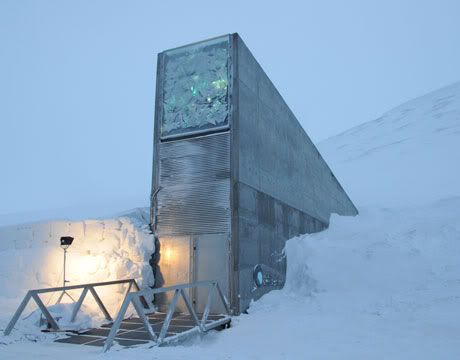
Deep in the Arctic, carved inside a stone mountain, lies the Doomsday Vault. It's a locked, airtight structure that contains something more precious than money or gold. It carries seeds. Half a million variety of crops from different countries all over the world.  It's our safety deposit box against climate change, wars or any catastrophes.

Last week, several chili pepper seeds like, Wenk's Yellow Hots, Pico de Gallos (this a common ingredient in salsa) and San Juan Tsile were added to the collection.  They were delivered by a delegation of US Senators.

"The journey of the chili pepper from the indigenous cultures of the Americas to its current status as an essential ingredient in many Indian and Asian cuisines is a marvelous example of the global disbursement of agricultural diversity," Senator Tom Udall said. "I'm very pleased that we are saving one of New Mexico's most famous and most delicious crops in the Svalbard Global Seed Vault."

Besides chili, they also brought other seeds like peanuts and melons. There is now approximately 250 million seeds in the vault, with each variety having 500 seeds.  Check out their database here.  We can expect that number to grow in the future, but I hope we don't have use them anytime soon.

Sources:
http://en.wikipedia.org/wiki/Svalbard_Global_Seed_Vault
http://www.valleymorningstar.com/news/spices-76967-chili-vault.html
http://news.bbc.co.uk/2/hi/science_and_environment/10603656.stm

Huwebes, Abril 22, 2010

something to laugh about

Someone brought imported candies and chocolates to the office this week. I got the ones I haven't tasted yet. I was so focused on what they would taste like that I didn't notice there was a joke on the wrapper--and I noticed just now that there are TWO jokes on the wrapper.  Here's one of them, it's pretty funny:

joke on wrapper

Little things like this do a lot to brighten a hard day. Sometimes, it's the only thing that keeps us going. It's such a blessing when we find something to laugh about despite a tragedy. Yesterday, I watched Jimmy Kimmel's compilation of reporters struggling to pronounce the name of that volcano in Iceland.


It's a big story. We all want to talk about it, we all want everyone to know about it and yet nobody knows how to say it! I don't even want to type it. Air travel stopped; businesses lost money. I bet there's a lot of people out there who wants to curse the volcano-- only problem is they don't know how to say its name!

Sources:
Laffy Taffy, Strawberry Fresa (joke by Patrick B., San Antonio Tx)

Miyerkules, Marso 17, 2010

little surprises

Days before my birthday I received a postcard from our town's vice-mayor. I didn't even know who our vice-mayor was. I know it must have something to do with the upcoming elections and he probably just pulled my name out of a list, but it was still a pleasant surprise for me. It was an early greeting and it came from someone really unexpected.


Then, around 30 minutes before midnight of my actual birthday, a friend from College sent me a text greeting. We hadn't spoken in a long time, so it was a great surprise as well. I'm happy she remembered. I know there was probably a notification from Facebook or the Birthday alarm.  Man, I'm so cynical!  But still, I love getting greetings like these.

Another person who greeted me was my old boss.  Again, I didn't expect I'd hear from him.  He's one of the people I truly respect and look up to.  I learned a lot from him-- about work, dealing with people, life.  Well, about a month ago, I found out that we're working on the same building.  I never had the chance to meet him again though, because he's on night shift and I work on daytime.  Well, this morning I had to come in early for a meeting and guess who I met at the lobby?  Another little birthday surprise for me.

My actual birthday (it was last weekend) was spent celebrating another person's birthday. I was out of town with friends, joining in on the festivities for one of the founders of our poetry group. The day was filled with good food, good conversation and fun people. We talked about our plans this year and what we're currently working on. These are the stuff I can't talk to anyone about (except my sister). It feels good to find a place for my creative endeavors. Before we went home, we picked green mangoes. Sir Rio said I owe him four poems for them. I better start working.

Linggo, Disyembre 13, 2009

Entomophagy


http://www.nuffy.net/articles/world-strangest-food.html
Entomophagy is the practice of eating insects--  grasshoppers, spiders, ants, scorpions, beetles and the like.  They're not what most people would normally have for lunch but they're a delicacy in countries such as Thailand, China and Mexico.  Here in Pinas, we still consider them exotic but there are some places where you can satisfy your cravings for an adobo or a fried beetle-- although I don't know exactly where those are and I haven't eaten anything like that yet.

According to the Entomological Society of America, insects generally contain more protein and are lower in fat than traditional meats.  In Central Africa, caterpillars and grubs are a source of protein and energy.  A study done by the UN states that:

"For every 100 grams of dried caterpillars, there are about 53 grams of protein, about 15 percent of fat and about 17 percent of carbohydrates. Their energy value amounts to around 430 kilocalories per 100 grams. The insects are also believed to have a higher proportion of protein and fat than beef and fish with a high energy value.

Depending on the species, caterpillars are rich in important minerals such as potassium, calcium, magnesium, zinc, phosphorus and iron, as well as various vitamins, the FAO study revealed. Research shows that 100 grams of insects provide more than 100 percent of the daily requirements of the respective minerals and vitamins."

Of course there are still risks involved.  We can't eat all insects-- and even those that are considered safe could have been exposed to pesticides and toxins.  It's best to get your bugs from a reliable and trusted seller, or maybe you can start a farm and raise your own.   I think it's best to start with crickets (kuliglig).  They're one of the most popular to eat and there's a ton of websites listed on Google about how to raise them.  Here's an easy one to follow from Wikihow.

Aside from being an alternative source of nutrition and energy, insects are also a potential source of income.  The website Insects are Food offers advice and assistance to Entomophagy entrepreneurs.  You can send them an email with your questions here: info@insectsarefood.com.

Sources:
http://www.thisislondon.co.uk/news/article-23489201-just-the-cricket-eating-insects-is-good-for-us-and-for-the-environment-scientists-claim.do
http://insectsarefood.com
http://www.afrol.com/articles/14734
http://www.locusviridis.co.uk/sections/archives/category/entomophagy

    Miyerkules, Oktubre 21, 2009

    snack time!

    The other day, I used a spoon that had some cheese spread on it to slice out a small portion of ube (purple yam). I was so surprised to discover that it tasted good. I almost ate the whole thing.

    I call this the Cezurple!
    So, I went online and researched how other snacks came to be..

    A dinner guest at Moon Lake Lodge (Saratoga, NY) kept complaining about the fried potatoes. He sent them back several times, saying they were too thick and soggy. The chef, George Crum, got so fed up with him, he decided to slice the potatos so thin they couldn't even be eaten with a fork. His plan backfired-- the guest loved it. Soon, it became a regular item in the menu, under the name "Saratoga chips". Today, it is more popularly known as the potato chip.

    Another interesting snack genesis is about how, in San Francisco 1905, a kid forgot that he had left some soda drink out on their porch. It was a cold night, so the drink froze to the stir stick. That day, Frank Epperson's Epsicle, now known as the Popsicle, was born.

    I tried looking for the origins of some of my favorite Pinoy delicacies. I wasn't able to find any :(. A lot of them seem to have come from other countries. The Chinese gave us siomai and siopao, as well as the balut. Empanada came from the Spaniards. But what about Halo-halo? Kropek? Otap? Belekoy? Sinukmane? Sapin-sapin? Each province in the Philippines boasts of their locally made products yet there are no records of where these delicacies originated.

    I'm still searching for a legit origin of a Pinoy delicacy. I know I'll find one soon, and I'll be writing about it here. For now, I'm happy discovering (and eating!) a different treat for every island I visit.

    Sources:
    http://www.ideafinder.com
    http://www.wikipedia.org


    Miyerkules, Setyembre 16, 2009

    the father of the green revolution


    2006 Norman Borlaug Congressional Gold Medal
    2006 Norman Borlaug Congressional Gold Medal
    "When the Nobel Peace Prize Committee designated me the recipient of the 1970 award for my contribution to the 'green revolution', they were in effect, I believe, selecting an individual to symbolize the vital role of agriculture and food production in a world that is hungry, both for bread and for peace." - Dr. Norman Ernest Borlaug (1914-2009)

    Norman Borlaug was born on a farm near Cresco, Iowa in March 25 1914.  He spent his childhood and teenage years working with the crops and animals.  In 1933, at the urging of his grandfather, he left the farm and enrolled at the University of Minnesota.

    His encounters with the unemployed and the starving during the Great Depression shaped his outlook on life.  It was also around this time that he met Prof. Elvin Stakman.  He became involved in Stakman's research on plant breeding methods and the professor suggested that he take up Plant Pathology.

    In 1944, he became part of The Cooperative Wheat Research Production Program, which focused on increasing wheat production in Mexico.  It was not easy.  They didn't have enough training and equipment, and the local farmers refused to cooperate.  The epilogue of his book, "Norman Borlaug on World Hunger", reveals his initial regret.  He wrote: "It often appeared to me that I had made a dreadful mistake in accepting the position in Mexico,".

    But after several years of research, harvest time finally arrived.   He developed Pitic 62 and Penjamo 62, two disease-resistant varieties of wheat that produced more grain than usual.  By 1963, Mexico achieved production six times larger than in 1944.  95 percent of the crops were Borlaug's varieties.

    After Mexico, his wheat strains were sent to India and Pakistan.  In five years, Pakistan's wheat yields increased dramatically from 4.6 million tons to 7.3 million tons.  By 1968, Pakistan became self-sufficient in wheat production.

    India produced 20.1 million tons of wheat in 1970. There wasn't enough labor to harvest the crops; not enough carts to bring it to the threshing floor; not enough jute bags, trucks, rail cars, and grain storage facilities. They even closed down schools to use the buildings for grain storage.  They were also able to save 100 million acres of virgin land from being converted into farmland.

    He began work in Africa in 1984 with Ryoichi Sasakawa, chairman of Japan Shipbuilding Industry Foundation.  Production of maize, sorghum, wheat, cassava and cowpeas increased.  The project will also be extended to Benin, Burkina Faso, Ethiopia, Ghana, Guinea, Mali, Malawi, Mozambique, Nigeria, Tanzania, and Uganda.

    Norman Borlaug passed away last Saturday, Sept 12, 2009 at the age of 95.  He died of lymphoma.  A lot of us, though, didn't know who he was until now.  Scientists predicted that a global famine will happen because of the population explosion, but Norman's discoveries saved us all.  He led a very fruitful life that has yielded much to humanity.

    Sources:
    http://en.wikipedia.org/wiki/Norman_Borlaug
    http://news.yahoo.com/s/ap/20090913/ap_on_re_us/us_obit_borlaug

    Sabado, Setyembre 12, 2009

    Marquez and his urine

    As part of his pre-fight regimen, Juan Manuel Marquez drinks his own urine.  This practice is called Urophagia and it's part of a larger field of alternative medicine called Urine therapy.


    It's incredibly nasty but it has been in existence for a long time in several cultures.  A lot of sources say that it's best to drink morning urine, taken mid-stream.  You can start with a few drops and then work your way to a full glass.

    • Gargling for toothache and sore throat
    • Vaginal douche
    • Ear and eye drops for infections, glaucoma
    • Sniffing to clear sinuses and preventing colds
    • Application on the skin for massages, healing skin problems
    • Hair and scalp massage to stimulate hair growth
    • Drinking for meditation
    Although advocates say that there are tons of benefits from drinking urine, it's still best to take it with a grain of salt.  It tastes better!  Just kidding.  Aside from Wiki, I found this good article about this topic.  Will Marquez win the fight against Mayweather?  I don't know.  All I know is urine will never be my cup of tea.

    Sources:
    http://www.lifepositive.com/Body/traditional-therapies/urine-therapy.asp
    http://en.wikipedia.org
    http://www.youtube.com